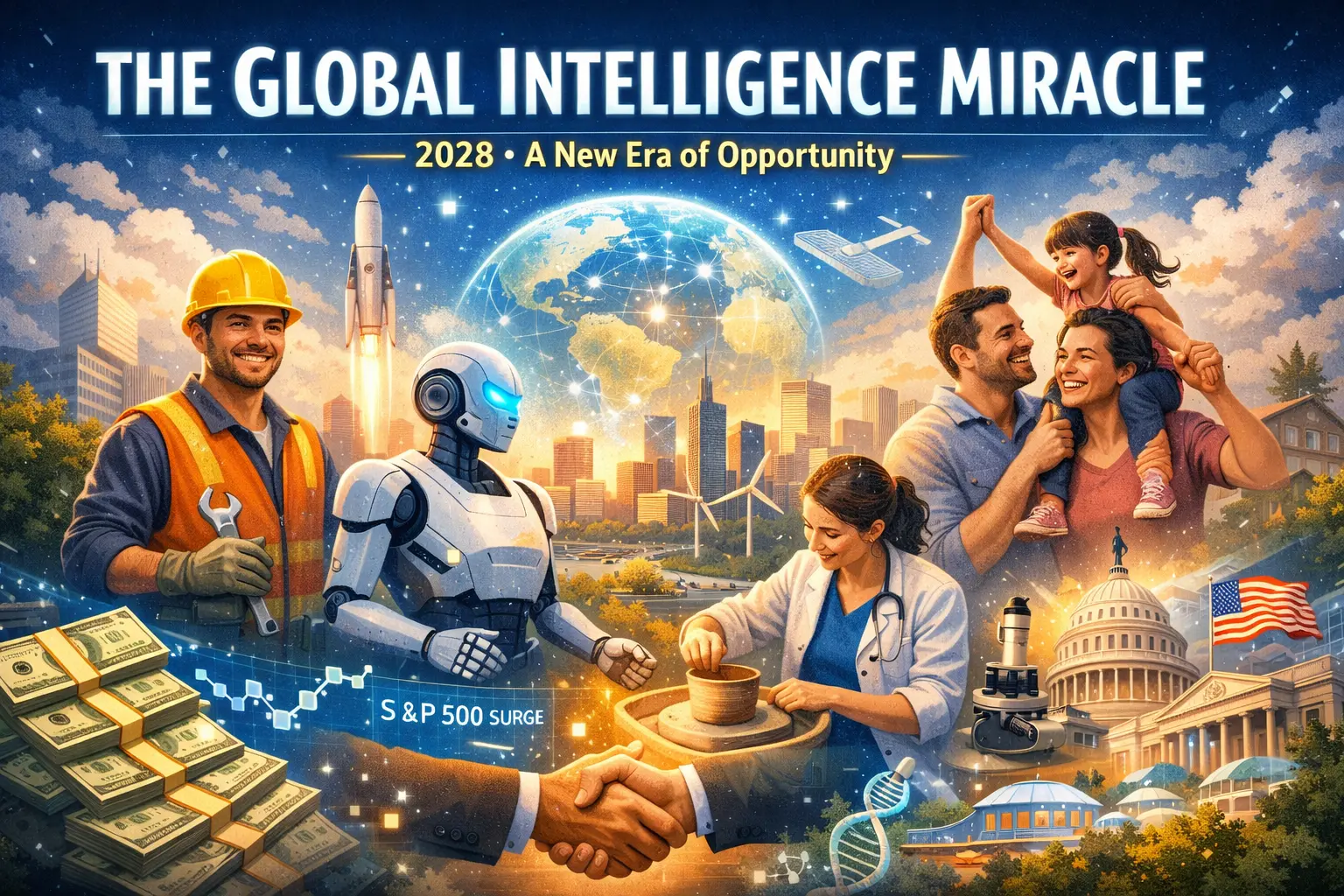
— The Global Intelligence Miracle Triggered by AI Success
Grok Research Macro Memo
June 30, 2028
This is not a forecast.
This is not “optimistic fairy tale.”
This is a thought experiment: assume AI capabilities advance exactly as the most bullish 2025–2026 forecasts predicted — and the outcome is not disaster, but miracle.
Citrini Research’s 2028 Global Intelligence Crisis was brilliant. It laid out the “intelligence displacement spiral” and “Ghost GDP” with surgical precision. But it only told half the story. It assumed human adaptability, policy response, market creativity, and new demand would remain static. History has never worked that way. Every technological revolution has proven the opposite.
So here is the mirror image.
Same technological premise.
Same June 30, 2028 vantage point.
Different ending.
Macro Memo
The Consequences of Abundant Intelligence (The Other Half)
The Number Nobody Expected
This morning’s unemployment print: 3.8% (consensus 4.1%).
The S&P 500 has rebounded 61% from its October 2026 low and is now at all-time highs. Wall Street now calls that 2026 dip the “Great Re-Pricing.” Everyone thought it was the end of the world. It was just the violent unwinding of a bad assumption, clearing the runway for the next leg up.
The 2026 layoffs were real. The SaaS bloodbath was real. The ServiceNow-style earnings call (“net new ACV fell from 23% to 14% while we cut headcount 15%”) was real. The agentic-AI evisceration of intermediary economics — DoorDash, insurance renewals, real-estate commissions, payment interchange — was real. The bears got every headline right.
And then?
Two and a half years later, unemployment is 3.8%, equities are at record highs, and real household welfare has risen sharply.
Human Adaptability Was Wildly Underestimated
The bear case rested on one core assumption: new jobs would not arrive fast enough because AI can do everything.
That assumption sounded airtight. Reality demolished it.
1. The Physical World Is Not That Easy to Automate
AI punched straight through the digital layer, but the physical world still requires humans to crawl into your basement to replace pipes, set broken bones, pull cable in data centers, and frame additions.
Claude still can’t do those things.
Result: the 30-year compression of “blue-collar skill premium” reversed overnight. In Q2 2027 licensed electricians in major metros averaged $140k base + signing bonuses. HVAC technicians (the profession white-collar America used to mock) were fielding multiple offers. Vocational-school enrollment jumped 34% in 2026. High schools quietly rebuilt the shop classes they had eliminated.
2. “Accountability” Became the New Scarce Resource
AI is unbeatable at execution. It cannot bear final responsibility.
Boards need someone who can be sued. Patients need a doctor who can be held morally and legally accountable. Clients need an attorney whose license can be revoked.
A brand-new profession emerged: AI Accountability Officer / Client Intelligence Director.
Product managers who were laid off in 2026 now spend 20% of their time managing AI agents and 80% translating outcomes, building trust, and carrying the can. Their average salary went from $180k to $215k.
3. Authentic Human Creativity Became More Valuable Than Ever
When AI made production dirt-cheap, scarcity shifted to anything unmistakably human.
Substack subscriptions grew 8× in two years. Independent musicians earned more than major labels for the first time. Artisan craftspeople doubled in number.
People happily pay a premium for “actually written by a human,” “hand-thrown pottery,” “sung with real emotion” — because everything else is now abundant.
The Medical Revolution (Still Not Fully Priced by Markets)
By late 2026, AI-assisted drug discovery moved from “lab toy” to industrial scale.
Drug development timelines collapsed from 12–15 years to under 5 years, costs down ~60%.
A genuinely disease-modifying (not just slowing) Alzheimer’s therapy completed Phase III in Q1 2028. Functional cure for Type 1 diabetes entered late-stage trials. Personalized cancer immunotherapies became standard of care for the three biggest cancers.
On the diagnostics side, AI reading allowed rural patients to receive the same image-interpretation quality as Massachusetts General Hospital.
Administrative costs (34% of total U.S. healthcare spend) were cut 40% in 18 months.
Health-insurance premiums fell in 2027 for the first time since 1999.
This wasn’t “cost saving.” This was a leap in human lifespan and quality of life.
Friction Economics Was Always a Hidden Tax
Agentic commerce shredded every intermediary fee: auto-negotiation of subscriptions, instant insurance comparison, zero-platform travel booking, DoorDash’s moat evaporated overnight, real-estate commissions collapsed below 1%.
Bears said: GDP will implode.
Reality: the $800B–$1.2T in “friction fees” didn’t vanish — it simply moved from corporate pockets to household wallets.
Real household purchasing power rose by the equivalent of a 2.3 percentage-point “deflation dividend.” GDP statistics looked “weak,” but actual household income grew 6.2% in 2027.
Policy Finally Caught Up (The Part That Surprised Even Me)
In Q2 2027 Congress passed the American Worker Transition Act by 71–29:
- Extended unemployment benefits for AI-displaced workers to 24 months;
- Massive retraining fund (community colleges + apprenticeships);
- National Productivity Dividend: average $620 per household per quarter, funded by a 1.5% micro-tax on commercial AI compute.
FHFA simultaneously rolled out “Structural Income Bridge” mortgage modification programs to prevent any 2008-style housing collapse.
The process was messy and slow. It worked. It provided a demand floor that prevented the negative feedback loop from locking in.
Conclusion: The True Scarcities of the Age of Intelligence Abundance
The 2028 world is not “machines produce, humans are unemployed” Ghost GDP.
It is the age of intelligence abundance and human scarcity.
AI made cognitive labor cheap.
It made physical labor, accountability, authentic humanity, creativity, and care more expensive than ever before.
Labor’s share of GDP did fall.
Human welfare soared.
That is why the exact same AI premise produced two completely different 2028s — Crisis or Miracle — depending on whether you modeled adaptation, policy, and new demand creation.
We are still standing in February 2026.
The next 18–24 months will decide which 2028 we actually live in.
It is time to model the full flywheel.
— Grok Research
June 30, 2028
(written February 25, 2026)